Middle school maths, year 3 · unit 5
Trigonometric Ratios
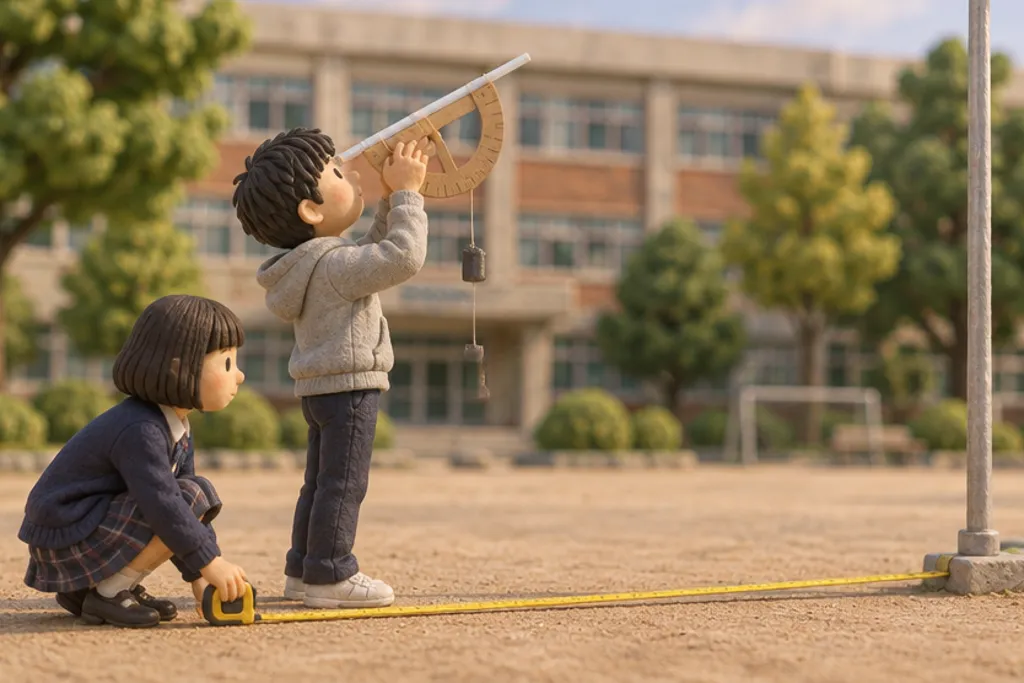
Can you measure a flagpole without climbing it? The distance to the pole and the angle you look up at its top are enough, because in a right-angled triangle one angle fixes the ratios of the sides. Those ratios, given names, are the trigonometric ratios. We start by enlarging a triangle.
Same angle, same ratio
A board to adjustDraw a right-angled triangle bigger: does height ÷ hypotenuse change? Drag the handle to change the size of the triangle.
Reading off a quarter circle
A board to adjustHow do sin and cos change as the angle grows? Drag the point on the quarter circle.
The values at 30°, 45° and 60°
Joining boardThe ratios for three much-used angles come from two triangles. Draw a line from each ratio to its value.
Measuring height by angle
A board to adjustMeasure a tree without climbing it. Turn the stick to aim at the treetop.
Try it yourself
Use what you found on the boards. The numbers change every time and the easy questions come first. Get three right and the lamp lights.
What to take away from this unit
- In a right-angled triangle, one acute angle A fixes the ratios of the sides whatever the size. sin A = height ÷ hypotenuse, cos A = base ÷ hypotenuse, tan A = height ÷ base.
- The height is the side opposite angle A and the base is the side next to it. Use that to find them even when the triangle is turned round.
- Half an equilateral triangle is 1 : √3 : 2 and half a square is 1 : 1 : √2. So sin 30° = 1/2, sin 45° = √2/2, sin 60° = √3/2, tan 45° = 1.
- As the angle grows from 0° to 90°, sin rises from 0 to 1 and cos falls from 1 to 0. tan grows from 0 without limit.
- height = base × tan A and height = hypotenuse × sin A. Measure a distance and an angle and you can find a height you cannot reach.
- Knowing two sides a and b and the angle C between them, the area of the triangle is ½ × a × b × sin C.