Middle school maths, year 3 · unit 1
Square Roots and Real Numbers
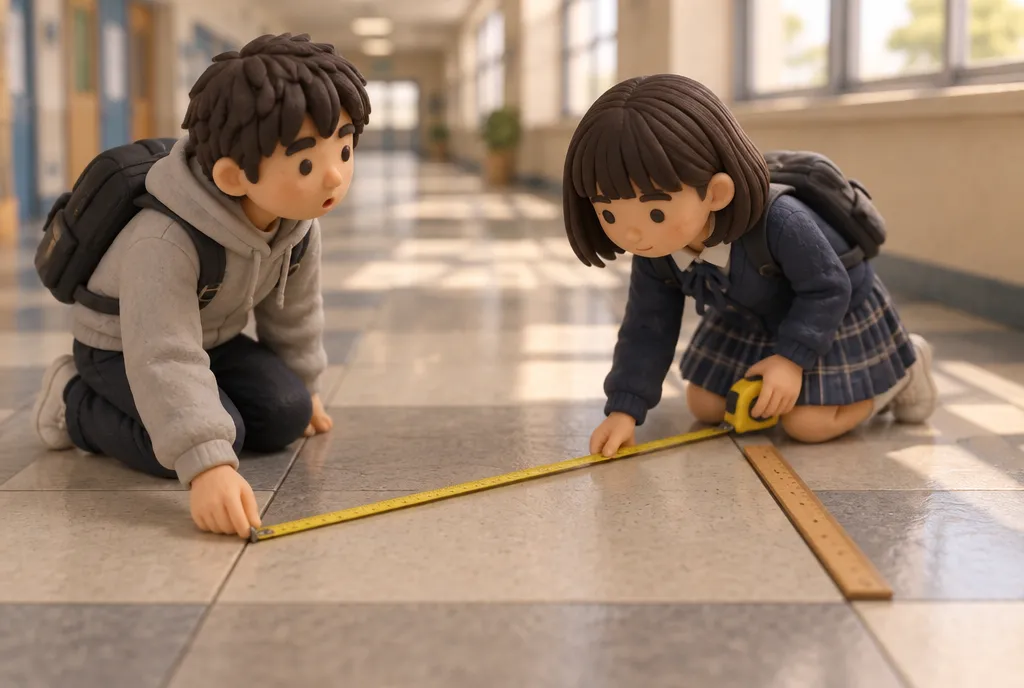
The side of a floor tile measures exactly, but its diagonal always falls between the marks however you measure. A length right in front of you, and none of the numbers you know can write it down. So a new symbol, √, was made. We start by working back from an area to a side.
From area back to side
A board to adjustA square of area 9 has side 3. So what is the side of a square of area 2? Drag the gold handle to build the squares.
Whereabouts is √2?
A board to adjustHunt in decimals for the number whose square is 2. Drag the handle to change the side and the area follows.
Its place on the number line
A board to adjustDoes a number that cannot be written out as a decimal still have a place on the number line? Swing the diagonal stick down onto the line.
Between which numbers?
A board to arrangeIs √5 more than 2, or less? Drag each card into the right box on the number line.
Bringing it outside
A board to adjust√8 and 2√2 are the same number. Join sticks end to end and grow the square to see why.
Only like with like
A board to arrangeIs √2 + √2 equal to √4? Lay the sticks end to end on the number line and compare the lengths yourself.
Try it yourself
Use what you found on the boards. The numbers change every time and the easy questions come first. Get three right and the lamp lights.
What to take away from this unit
- A number whose square is a is a square root of a. A positive number has two, one positive and one negative; the positive one is written √a and the negative one −√a. 0 has just one square root, 0, and a negative number has none.
- A number like √2 that cannot be written as a fraction is irrational. As a decimal it neither ends nor repeats. Rational and irrational numbers together are the real numbers.
- The real numbers fill the number line with no gaps. If a < b then √a < √b: the larger the number under the root, the larger the root.
- Multiply and divide the numbers under the roots: √a × √b = √ab and √a ÷ √b = √(a/b).
- A square number under the root can be brought outside: √8 = 2√2 and √18 = 3√2. The other way round, 2√3 = √12.
- Add and subtract only terms with the same root part: 2√2 + 3√2 = 5√2. √2 + √3 cannot be made simpler, and it is not √5.