Middle school maths, year 1 · unit 6
Basic Figures and Constructions
From here on it is shapes, not numbers. Two sticks that cross make angles; three sticks whose ends meet make a triangle. Look and turn things with your hands and there is very little to memorise. We start by laying one stick across another.
Angles facing each other are equal
A board to adjustTwo crossing sticks make four angles. Drag a gold end of the teal stick to turn it and watch how the four angles change.
A line crossing two parallel lines
A board to adjustWhen another stick crosses two sticks lying side by side, the same pattern of angles appears above and below. Drag the gold end to tilt it.
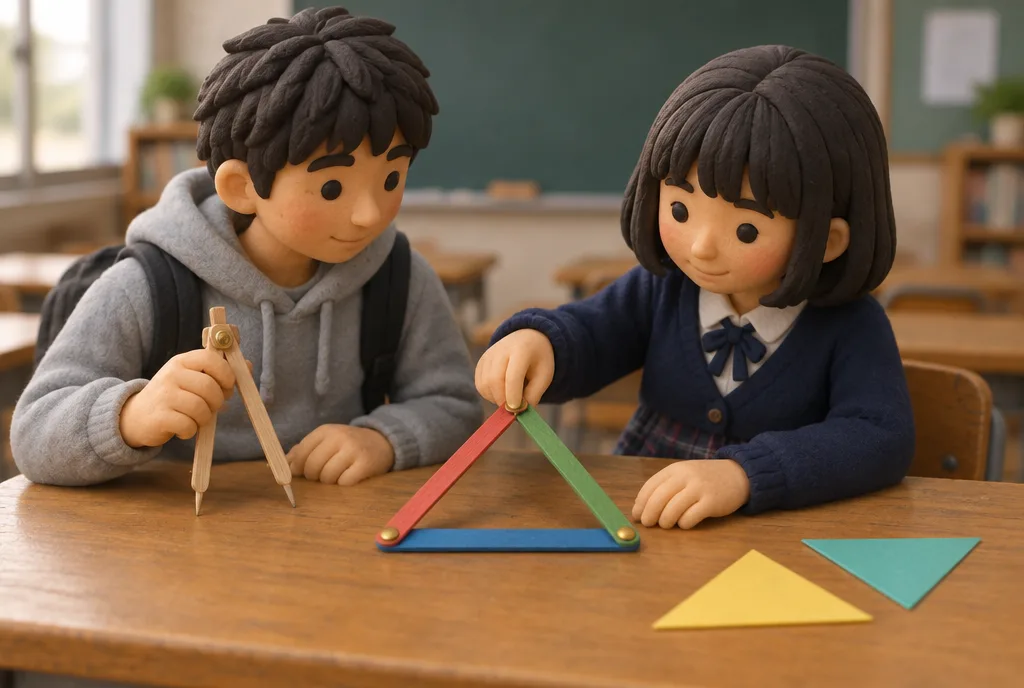
Making a triangle from three sticks
A board to arrangeDrag the ends of the two sticks pinned to the base until they meet, and you have a triangle. But can they always meet?
If they fit exactly, they are congruent
A board to arrangeYou need not measure all six parts of a triangle (three sides, three angles): if the right three match, they fit exactly. Drag the yellow triangle onto the one it will fit.
Try it yourself
Use what you found on the boards. The numbers change every time and the easy questions come first. Get three right and the lamp lights.
What to take away from this unit
- Of the four angles made by two crossing lines, the two facing each other are vertically opposite and always equal. Two neighbouring angles add up to 180°. Lines meeting at 90° are perpendicular.
- Two lines that never meet are parallel. When a third line crosses two parallel lines, corresponding angles are equal and so are alternate angles. And the other way round: equal corresponding or alternate angles mean the lines are parallel.
- Drawing figures with only an unmarked ruler and compasses is construction. Given three side lengths, you find where two arcs cross and draw the triangle.
- For a triangle to exist, the longest side must be shorter than the other two together. 7, 3 and 2 cannot make a triangle.
- Two figures that fit exactly on top of each other are congruent. There are three congruence conditions for triangles: three sides (SSS), two sides and the included angle (SAS), one side and the angles at its ends (ASA).