Middle school year 3 · fifth unit
Stimulus and Response
Seeing a ball coming and dodging it takes less than a second. In that instant the eye takes it in, nerves carry it, the brain decides and muscles move. Follow the path the signal takes through the body.
Walk into a dark cinema and at first you cannot see
A board to adjustAfter a moment you begin to see. What did the eye change? Take the torch and drag it toward the eye.
Look up from a book to the window and it is sharp at once
A board to adjustThat is because the lens inside the eye changes shape. Take the candle and drag it nearer the eye, then farther.
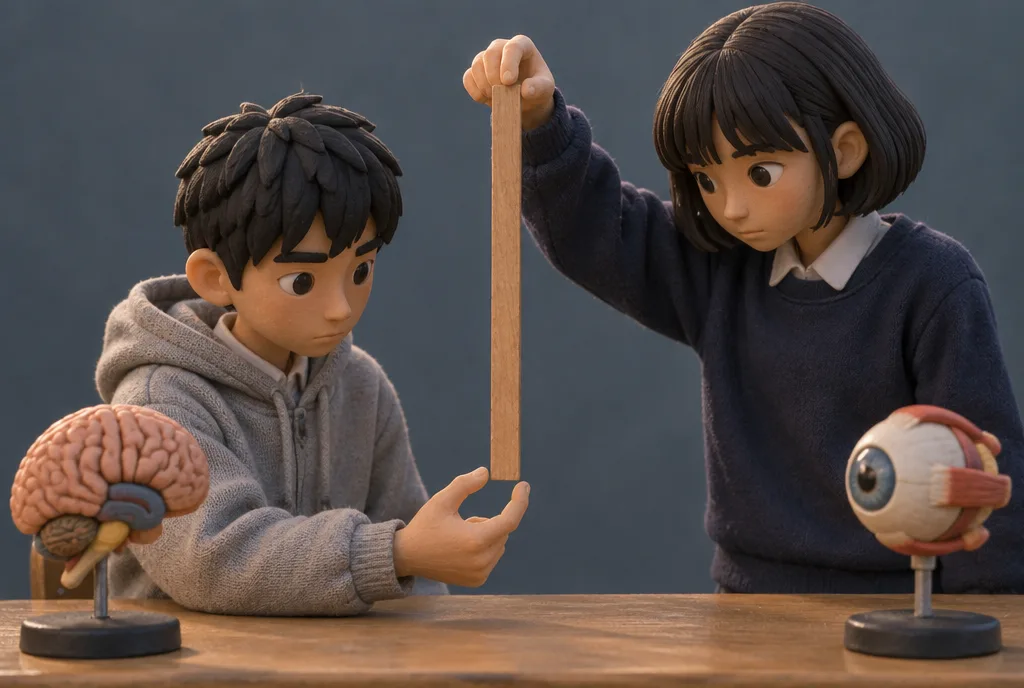
How fast can you catch a falling ruler?
A board to runYou might think you catch it the instant you see it, but you do not. Tap the picture to get ready, then tap again when the ruler falls.
Touch something hot and your hand is away before you think
A board to arrangeSome responses are decided by the brain; for others there is no time. Drag the pictures below onto the body.
Fed or fasting, the sugar in the blood stays about the same
A board to arrangeWhat keeps it level? Drag the meal or the shoe onto the graph.
What to take away from this unit
- Sense organs take in stimuli. The eye takes in light, the ear sound and the tilt of the body, the nose and tongue chemicals, the skin touch, temperature and pain.
- In the eye the iris changes the size of the pupil to control the light, and the lens changes thickness to form an image on the retina.
- The nervous system carries stimuli, decides and gives commands. The brain and spinal cord are the central nervous system; the nerves spread through the body are the peripheral nervous system. Its cells are neurons.
- A response decided by the cerebrum is a conscious response; one ordered directly by the spinal cord or similar, without the cerebrum, is a reflex. Reflexes are fast and protect the body.
- Hormones come from endocrine glands and travel in the blood to regulate the body: slower than nerves, but longer lasting. Blood sugar is kept steady by insulin and glucagon, body temperature by orders from the diencephalon. This is homeostasis.