Middle school year 3 · sixth unit
Reproduction and Heredity
How did I, once a single cell, become tens of trillions of cells? Why am I like my parents and yet not the same? The answers lie in how cells divide, and in the genes that are shared out when they do.
How does one cell become two?
A board to adjustSimply cutting it in half would halve the genetic material too. Drag the gold handle to step through how a cell divides.
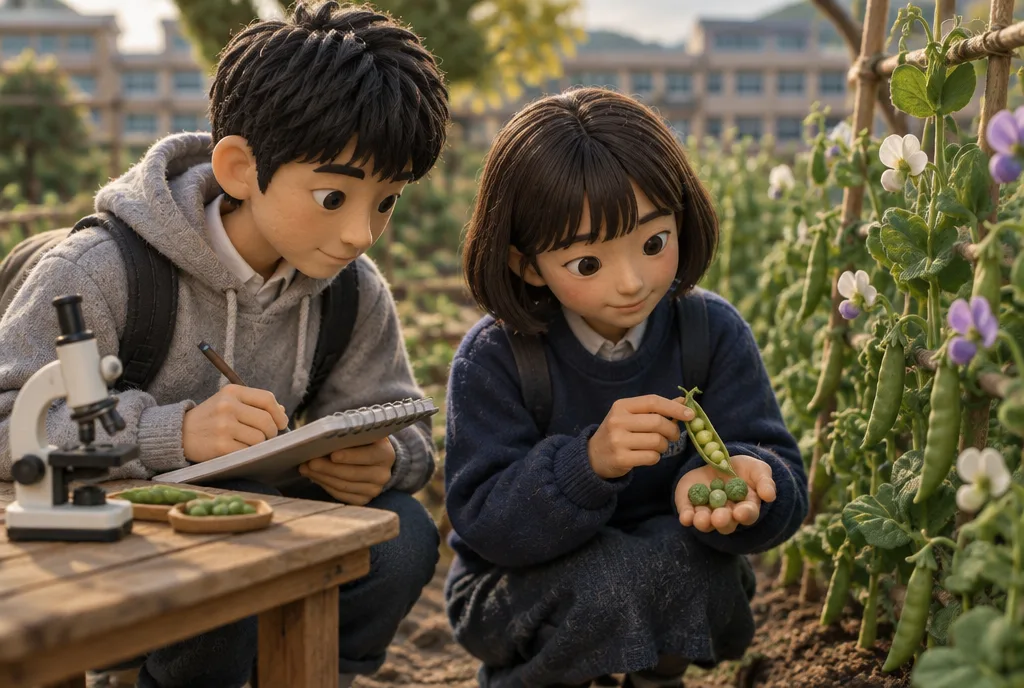
Round peas were crossed, and a wrinkled pea appeared
A board to arrangeThis is the rule Mendel found in his pea garden. Drag gene pieces into the parents’ places.
Can parents of types A and B have a type O child?
A board to arrangeThey can. Drag pieces to change the parents’ genes and see their children’s blood types.
Why is red-green colour blindness commoner in males?
A board to arrangeBecause of where the gene sits. Drag pieces to change the parents’ X chromosomes.
What to take away from this unit
- A cell that grows large finds it hard to exchange materials, so it divides. Mitosis copies the genetic material and shares it equally between 2 daughter cells. This is how the body grows and wounds heal.
- Meiosis divides twice in a row to make 4 reproductive cells with half the chromosomes. When sperm and egg meet in fertilisation, the number is restored.
- The fertilised egg divides again and again by mitosis, forming tissues and organs until it is a whole individual. This is development.
- Genes come in pairs and part, one into each reproductive cell (the law of segregation). When two different genes meet, the trait that shows is dominant and the hidden one recessive.
- Human heredity is studied through pedigrees and twin studies. ABO blood type has three genes, and when a gene lies on the X chromosome, as for red-green colour blindness, it shows up at different rates in males and females.