Middle school year 3 · first unit
Regularities in Chemical Reactions
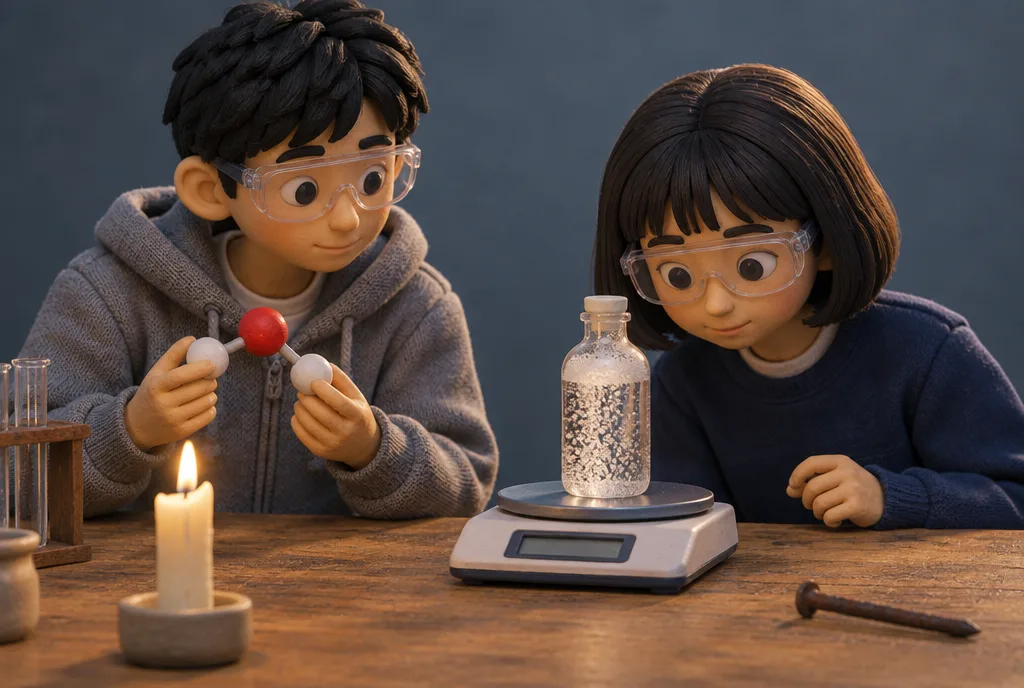
Paper burning and a nail rusting are substances turning into other substances. It may look haphazard, but there are rules in it that have never once failed. Count atoms and use a scale to find them.
How does ice melting differ from paper burning?
A board to arrangeBoth look different afterwards, but one can be undone. Drag the six changes into two dishes.
Hydrogen and oxygen meet and make water
A board to arrangeDoes any mixture turn entirely into water? Drag hydrogen and oxygen molecules into the left circle.
Wood burns and only ash is left. Where did the mass go?
A board to adjustIt only seems to vanish. Drag the tablet into the bottle and compare with the stopper in and out.
A hand warmer heats when shaken; a cold pack chills when snapped
A board to arrangeNo flame was lit and no ice was added. Drag a dish into the beaker and watch the temperature.
What to take away from this unit
- If only the shape or state changes and the substance stays the same, it is a physical change; if it becomes a quite different substance, it is a chemical change. In a chemical change atoms pair up afresh into new molecules.
- A chemical equation writes a chemical change in element symbols. The kinds and numbers of atoms must match on both sides of the arrow: 2H₂ + O₂ → 2H₂O.
- The total mass of the substances is the same before and after a reaction. This is the law of conservation of mass: atoms are neither made nor destroyed.
- The mass ratio of the elements in a compound is always the same. This is the law of definite proportions. In water, hydrogen and oxygen always combine as 1 : 8.
- When gases react, their volumes are also in a simple whole-number ratio (the law of combining volumes): 2 volumes of hydrogen and 1 of oxygen make 2 of water vapour.
- A chemical reaction that gives out heat is exothermic; one that takes it in is endothermic.