Middle school year 2 · seventh unit
Electricity and Magnetism
The snap from a door handle in winter and the lamp that comes on at a switch are the same electricity. It cannot be seen, but it moves by rules, and when it flows it even acts as a magnet. Fit cells and move compasses to find those rules.
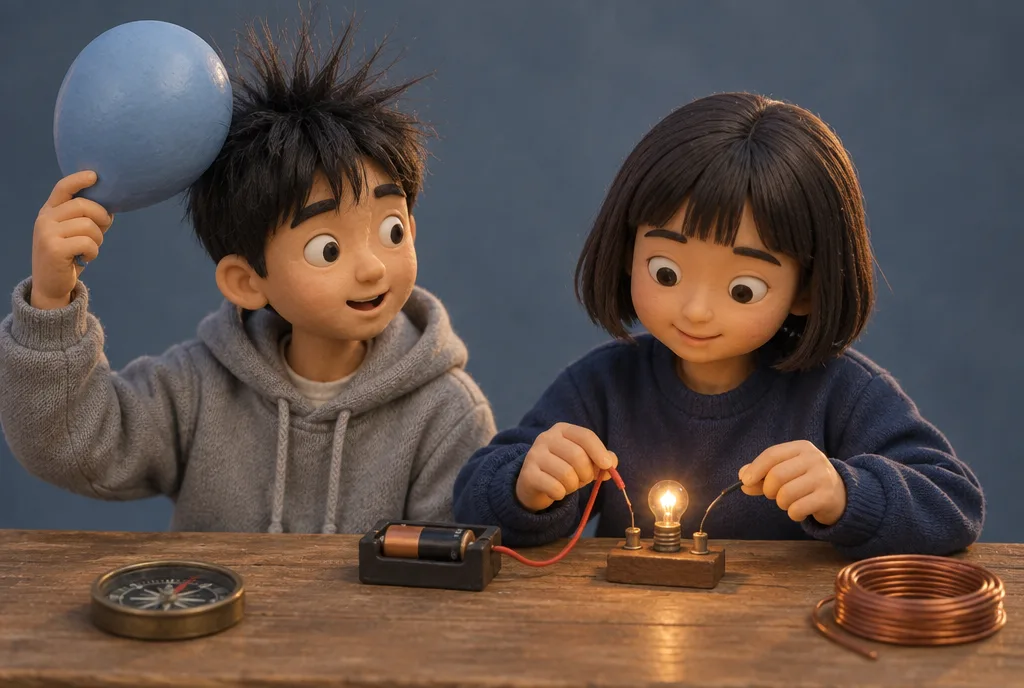
A sweater crackles as it comes off
A board to adjustWhy does rubbing alone make electricity? Take the balloon, rub it on the wool, then bring it near the bits of paper.
Add more cells and the bulb gets brighter
A board to arrangeHow much brighter? Drag cells in, and tap the resistor to change it.
There are two ways to connect two bulbs
A board to arrangeWhich way is brighter? Drag the second bulb into each of the two places in turn.
A compass placed by a wire moved its needle
A board to adjustA wire carrying current behaves like a magnet. Drag the compass round the wire.
What to take away from this unit
- Rubbing two different things together moves electrons and charges them (static electricity). Like charges repel and unlike charges attract. When a charged object comes near, the charges in another object shift: this is electrostatic induction.
- Current is the flow of charge (unit A), voltage is the ability to drive a current (unit V), and resistance is how much the current is hindered (unit Ω).
- Current = voltage ÷ resistance. This is Ohm's law. Double the voltage and the current doubles; double the resistance and the current halves.
- In series there is one path, so the current is the same everywhere and a single break puts everything out. In parallel the path divides, each device gets the same voltage, and the rest stay on when one goes out.
- Round a wire carrying current there is a magnetic field. Coil the wire many times and it is an electromagnet; a current-carrying wire between magnets feels a force, and that force turns a motor.