Middle school year 2 · eighth unit
Stars and the Universe
The stars are too far to visit or to measure with a ruler. Yet we know their distances and temperatures, and even that the universe is growing. Follow how all this was worked out from light alone.
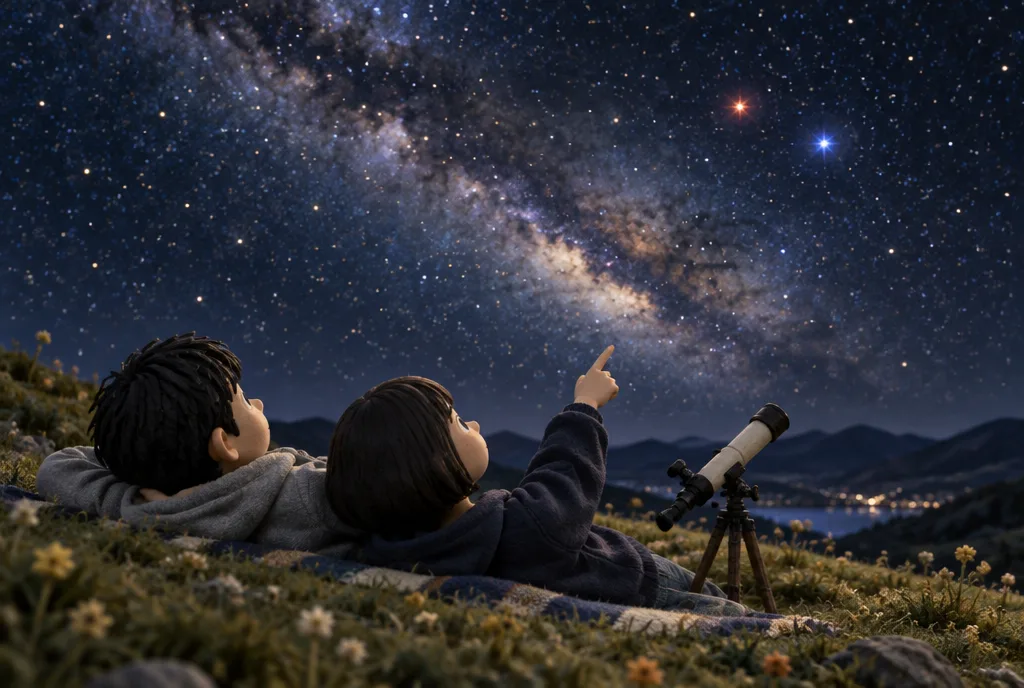
How is the distance to a star measured?
A board to adjustClose one eye and then the other, and a finger held near seems to jump. Stars do the same. Take the star and move it farther and nearer.
Is a star that looks bright really a bright star?
A board to adjustIt may only look bright because it is near. Take the star and drag it away from Earth and back.
Why are stars different colours?
A board to adjustSome stars are red and some are blue. Drag the knob on the scale to change the temperature of the star.
The farther a galaxy is, the faster it recedes
A board to adjustIs that because we are at the centre of the universe? Take an outer galaxy and drag it to stretch the universe.
What to take away from this unit
- As Earth goes round the Sun, a near star seems to shift a little among the far ones. Half of that angle is its annual parallax. The nearer the star, the larger the parallax, so parallax gives the distance.
- Apparent magnitude is how bright a star looks from Earth; absolute magnitude is how bright it would look with every star at the same distance (10 pc). The smaller the number, the brighter, and one magnitude is about 2.5 times.
- The colour of a star is set by its surface temperature: cool is red, hot is blue. The Sun is a yellow star at about 5800 K.
- The solar system lies in our galaxy, a disc with spiral arms reaching out from a bar-shaped centre, about 100,000 light-years across. In it are star clusters, where stars gather, and nebulae, where gas and dust gather.
- The universe is expanding. The farther a galaxy is, the faster it recedes, and the expansion has no centre. Run it backwards and you reach the Big Bang theory: the universe began from a single point.