Middle school maths, year 2 · unit 7
Properties of Triangles and Quadrilaterals
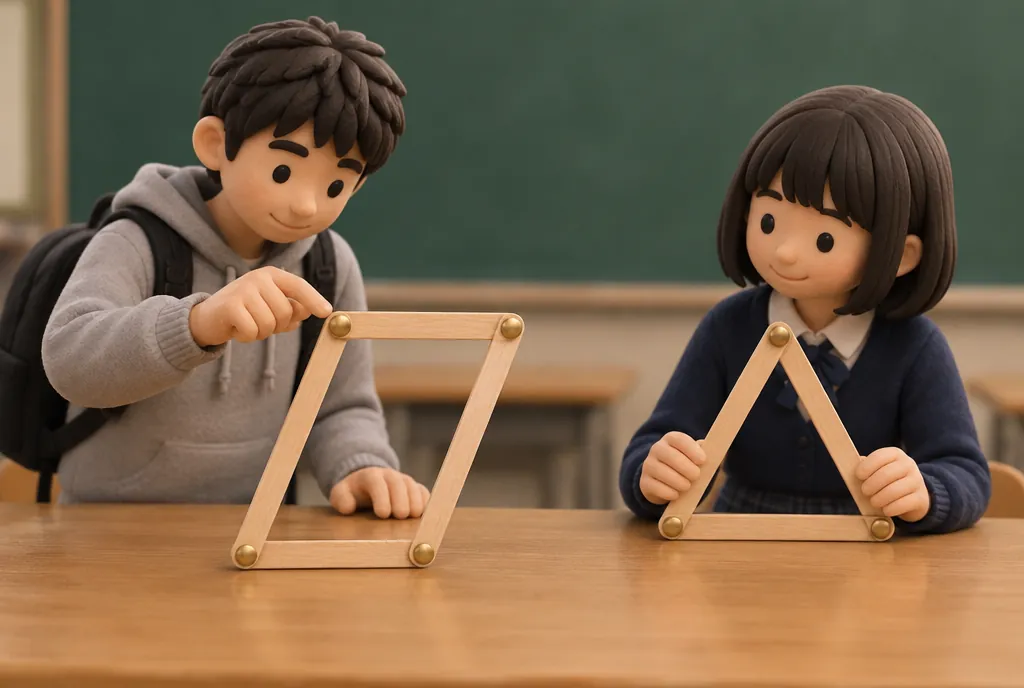
A frame of four sticks pinned at the corners leans when you push it. The sides stay the same length but the shape changes. Even so, opposite sides are always parallel and opposite angles always equal. Every shape has properties like these that do not change. We start with a stick triangle.
Equal sides, equal angles
A board to adjustHere is a triangle made of three sticks. Drag the gold vertex to make two sides equal. What happens to the angles?
A point equally far from three places
A board to adjustLines run from a point inside the triangle to its three vertices. Drag the gold point to find where the three lengths are equal.
What makes a parallelogram
A board to adjustThis quadrilateral has one corner out of place. Drag the gold vertex D to turn it into a parallelogram.
The quadrilateral family
A board to adjustStand a parallelogram upright and it is a rectangle; match its sides and it is a rhombus. Drag the gold vertex to change its shape.
Try it yourself
Use what you found on the boards. The numbers change every time and the easy questions come first. Get three right and the lamp lights.
What to take away from this unit
- The two base angles of an isosceles triangle are equal. The bisector of the apex angle is the perpendicular bisector of the base. A triangle with two equal angles is isosceles.
- The circumcentre is equally far from the three vertices (centre of the circumcircle); the incentre is equally far from the three sides (centre of the incircle). In a right-angled triangle the circumcentre is the midpoint of the hypotenuse.
- In a parallelogram both pairs of opposite sides are equal, both pairs of opposite angles are equal, and the diagonals bisect each other. The other way round, any one of these makes a parallelogram.
- A parallelogram with a right angle is a rectangle (equal diagonals); with two neighbouring sides equal it is a rhombus (perpendicular diagonals); with both it is a square.