Middle school maths, year 1 · unit 5
The Coordinate Plane and Graphs
A cinema seat takes two things to find, like "row E, seat 7". A point on a plane is named by two numbers in the same way. Once it is, rules turn into pictures and pictures can be read as stories. We start by planting flags on a lawn.
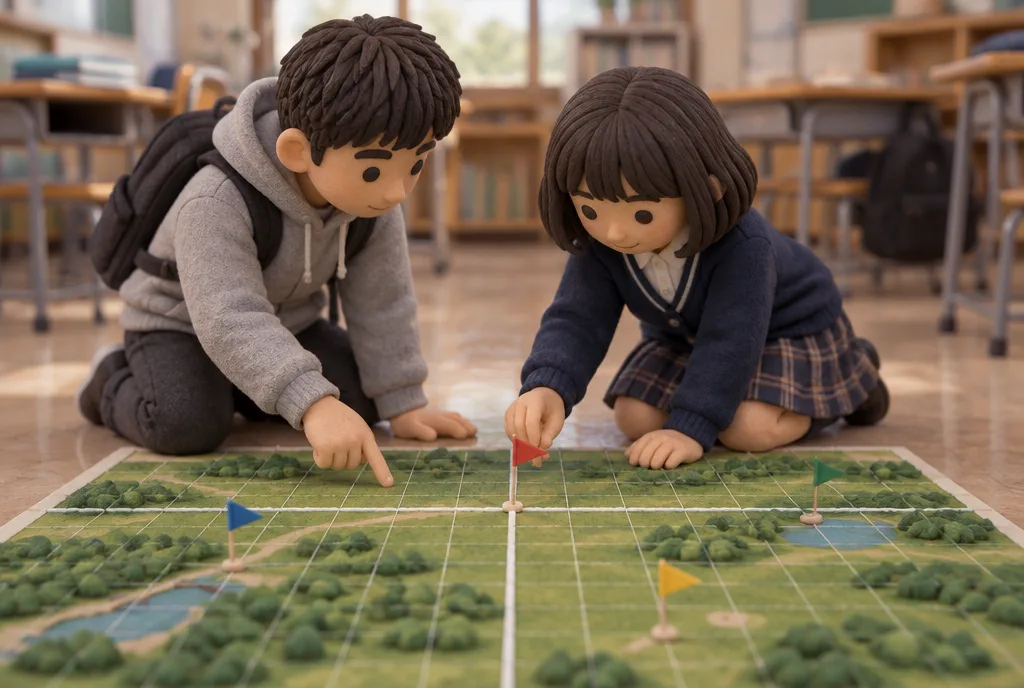
Two numbers name a point
A board to arrange(3, 2) is 3 to the right and 2 up from the origin. Drag the flag and plant it where you are told.
A graph is a story you read with your eyes
A board to adjustThis graph shows how time and distance changed on the way from home to school. Drag the gold handle to let time pass.
Doubling and tripling together
A board to arrangeEach plate holds 2 candies. How do the candies grow as the plates do? Drag plates into place.
Double one, halve the other
A board to adjustShare 12 chocolates equally between plates. More plates means fewer on each. Drag the gold handle to change the number of plates.
Try it yourself
Use what you found on the boards. The numbers change every time and the easy questions come first. Get three right and the lamp lights.
What to take away from this unit
- Two number lines crossing at 0 at right angles make the coordinate plane. Across is the x-axis, up is the y-axis, and they meet at the origin. A point is named by an ordered pair (x-coordinate, y-coordinate). (3, 2) and (2, 3) are different points.
- The four regions cut out by the axes are the quadrants. The top right is Quadrant I, then II, III and IV going anticlockwise. Points on an axis are in no quadrant.
- A graph shows how two quantities are related, as points or a line. Rising means increasing, flat means unchanged, and steeper means changing faster.
- If y doubles and triples when x does, that is direct proportion. The rule is y = ax and the graph is a straight line through the origin.
- If y halves and drops to a third when x doubles and triples, that is inverse proportion. The rule is y = a/x, x × y always equals a, and the graph is a smooth curve.