Concepts explained
Why Mass Came to Change — How a Two-Hundred-Year Law Became 'Almost Right'
Mass conservation, established by Lavoisier in 1789, became the foundation of chemistry and is still in the textbooks. Yet since 1905 physicists have called it a law that is 'almost right', because mass, it turned out, can turn into energy. Here is what changed and what stayed.
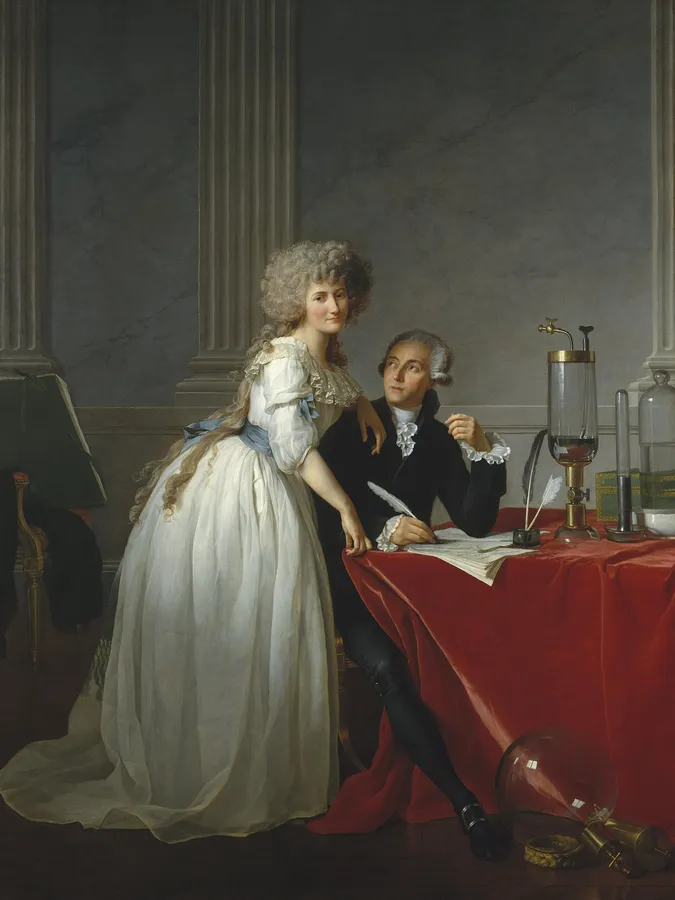
The first four pieces of this series dealt with quantities that do not change. This one is different. It deals with a quantity believed unchanging for two hundred years, on which all of chemistry was built, that turned out to change under certain conditions. What happened to mass is the best example of how science corrects a law.
1789: the sealed glass vessel
Eighteenth-century chemistry could not explain fire. Burn a metal and it grew heavier; burn wood and it grew lighter. There was a theory that something (phlogiston) escaped, but it could not explain the metal growing heavier.
Lavoisier answered with a precision balance and sealed vessels. The weight of everything before a reaction equalled the weight of everything after. The metal grew heavier because it had bound something from the air (oxygen); the wood grew lighter because it had left as gas. He declared: in a reaction, mass is neither created nor destroyed. The .
Chemistry was rebuilt on this law. Balancing the atoms on both sides of an equation, calculating molecular weights, measuring yield against raw material in industry: all assume mass conservation. To give this piece's conclusion first: in chemistry that assumption is, to this day, effectively exact.
1905: mass gets a price tag
Following his 1905 paper on , Einstein wrote a short three-page note. Its conclusion is one line: if a body gives off energy E, its mass decreases by E divided by the square of the speed of light. In the familiar form, E=mc².
The meaning is this. and are not two different things but two names for one thing. The exchange rate is c², about 9×10¹⁶. One gram of mass equals about ninety trillion joules of energy, roughly a day's electricity for the city of Seoul.
How much lighter does a candle get?
A whole candle burning gives off about a million joules of heat. Divide by c² and you get about 0.000000011 g, roughly a hundred-millionth of a gram, or 11 nanograms.
Where did that mass go? A sealed glass vessel traps the gases, but not the heat and light. The whole vessel grows lighter only by the heat and light that pass out through the glass. In a vessel that let no heat escape at all, the mass of the hot vessel would stay exactly the same, because heat energy counts as mass too.
How small is a hundred-millionth of a gram? The most sensitive laboratory balances resolve about a ten-millionth of a gram. The candle's difference is about ten times smaller still, and it would have to be picked out on top of a candle, its oxygen and a glass vessel weighing hundreds of grams. Even the best balances today cannot really do that. So mass conservation is in fact broken in chemical reactions, but by too little for any balance to show. A chemist using mass conservation is not using a wrong law but an approximation whose error is as good as zero.
When the atomic nucleus is involved, things change.
1932: enough vanishes for a scale to notice
After Chadwick discovered the neutron, nuclear masses could be measured precisely. Then something odd appeared. A helium nucleus weighed about 0.7% less than two protons and two neutrons weighed separately and added. The missing mass had left as energy when the nucleus bound together. It is called the mass defect. In nuclear reactions the change in mass is a few parts in a thousand, and the scale notices.
Uranium fission was discovered in 1938, and in 1942 Fermi ran the first reactor in Chicago. When a kilogram of uranium fissions, about one gram crosses from mass to energy: the heat of burning some three million kilograms of coal. Nuclear power came out of the very crack where Lavoisier's law breaks.
The Sun converts about four million tonnes of mass into light every second. It has done so for 4.6 billion years and will for perhaps five billion more. All life on Earth lives on energy from the breaking of mass conservation.
So what is conserved?
If mass conservation broke, is there one conservation law fewer? No. Laws were merged. Mass conservation and energy conservation were not two separate laws but one law (conservation of mass-energy) that had been known in two pieces. Mass entered the sentence from the energy piece, 'energy only changes form', as one more of its forms.
Back to the question at the end of the momentum piece: how can light, with zero mass, have momentum? In relativity, momentum is not mass times velocity but a quantity closer to energy, and light has energy, so it has momentum. Mass is not required. Newton's formula was an approximation valid only for slow things.
If you know this (almost) does not change, what can you find out?
Balanced equations, atomic weights, molecular formulas. Two hundred years of chemistry since Lavoisier stand on mass conservation, and within its range it has never once failed.
Measure how much lighter a nucleus is than the sum of its parts and you know how tightly it is bound. Iron is the tightest, which is why stars make elements only up to iron.
Divide the Sun's output by c² to get the mass lost each second: about four million tonnes. Simply dividing the Sun's whole mass by that gives fifteen trillion years, which is wrong. The Sun burns only about a tenth of its hydrogen, in the core, and only 0.7% of the hydrogen's mass becomes light. Put those two into the sum and you get about ten billion years.
Smash two particles together fast enough in an accelerator and kinetic energy turns into mass, making heavy particles that did not exist before. The Higgs boson was made this way.
Six pieces are done: four things that do not change, and one believed unchanging until its range was learned. The preface began with a physicist's ten-year-old shoes. Even those shoes wear, a very little at a time. 'Does not change' never means 'not at all'; it means 'not within the range I can measure', and knowing that range is what science is.
The question that remainsIf mass is one form of energy, where does mass come from? Ninety-nine percent of a proton's mass is not the mass of the quarks inside it but the energy of the force binding them. Most of your body weight is not the weight of matter but the energy of binding.