Concepts explained
Why Angular Momentum Does Not Change — Why Pulling Your Arms In Makes You Spin Faster
A figure skater pulls her arms in and spins faster, though nobody pushed her. The quantity of turning is conserved. Kepler saw it first in the planets in 1609, and it is why the solar system is flat.
is the 'quantity of turning': roughly mass, times distance from the axis, times the speed of turning. If the distance shrinks, the speed must grow for the product to stay the same. That is why the skater with her arms in spins faster.
1609: what the planets showed first
The first place people saw this law was the sky. After years poring over Tycho Brahe's records of Mars, Kepler found two things: a planet's path is an ellipse, and a planet moves faster when near the Sun and slower when far, by exactly the rule that it 'sweeps equal areas in equal times'. That is Kepler's second law.
Kepler did not know it, but that rule is the conservation of angular momentum itself. Closer to the Sun (smaller distance) means faster; farther means slower. The skater with her arms in and the planet Mars obey the same law.
Newton found the reason. The Sun's pull on a planet always points toward the Sun, that is, toward the centre of the turning. A force toward the centre produces no twist (torque) whatsoever that could speed the turning up or slow it down. So the quantity of turning does not change.
Why the solar system is flat
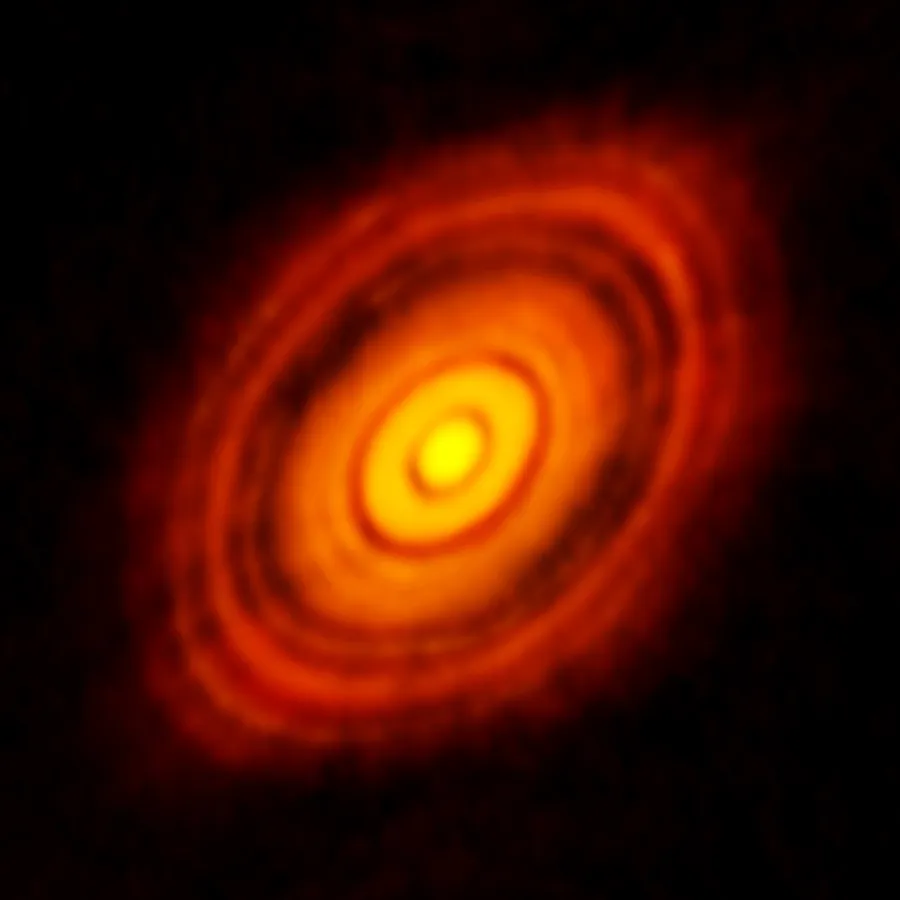
Four and a half billion years ago the solar system was a vast cloud of gas, turning very slightly. As it shrank under its own gravity, the turning sped up as the distance shrank. Faster turning pushed the cloud outward, but there was no such push along the axis of rotation, so it flattened in that direction only. The result was a disc, and the planets were born in that disc. That is why they orbit in nearly one plane, all the same way.
Galaxies being flat, Saturn's rings being thin, discs forming around black holes, pizza dough spreading as it spins: all because angular momentum has nowhere to go.
Why the Earth slows and the Moon recedes
The ocean tides slow the Earth's rotation, very slightly. The day lengthens by about two thousandths of a second per century. The angular momentum the Earth loses cannot vanish. The Moon takes it. With more angular momentum its orbit grows, and it recedes by about 3.8 centimetres a year. Lasers fired at reflectors the Apollo astronauts left on the Moon measure this distance directly. One conservation law ties the length of the day and the distance of the Moon on a single string.
Why it does not change
again. If the result is the same however you orient the apparatus, that is, if the laws are under rotation in space, there is one conserved quantity, and it is angular momentum. Energy is 'whenever', momentum is 'wherever', angular momentum is 'whichever way'. The three are three ways in which time and space are fair.
The twentieth century added one thing. Particles such as the electron carry angular momentum without turning. It is called . A quantity of turning with nothing turning is one of the strange points of quantum mechanics, and it must be included for the total angular momentum to add up.
If you know this does not change, what can you find out?
If a star the size of the Sun shrinks to the size of a city, it must turn hundreds of times a second. Such neutron stars (pulsars) exist. Know the size and you can predict the speed.
Satellites turn themselves without fuel by spinning internal wheels (reaction wheels). The wheel turns one way, the satellite the other. Sum: zero.
A falling cat with nothing to push against rights itself by turning its front and back halves in turn, keeping the total at zero while changing its orientation.
Add up the spins of the fragments after a particle decays and you learn the spin of the original. A basic tool for classifying new particles.
Across three pieces we have seen three conservation laws born of the symmetries of time, space and direction. The next piece is different in kind: a quantity born not of a visible symmetry of space but of a symmetry hidden in electricity. Charge.
The question that remainsIs the angular momentum of the whole universe zero, or is the universe itself turning very slightly? Observation points to 'almost zero', but why it should be so is not yet explained.