Concepts explained
Why Momentum Does Not Change — Collide, and the Sum Stays
When two balls collide, each one's speed changes, but mass times velocity added up over both is the same as before. It is why a rocket moves in a vacuum, and why nothing sets off on its own without something outside to push it.
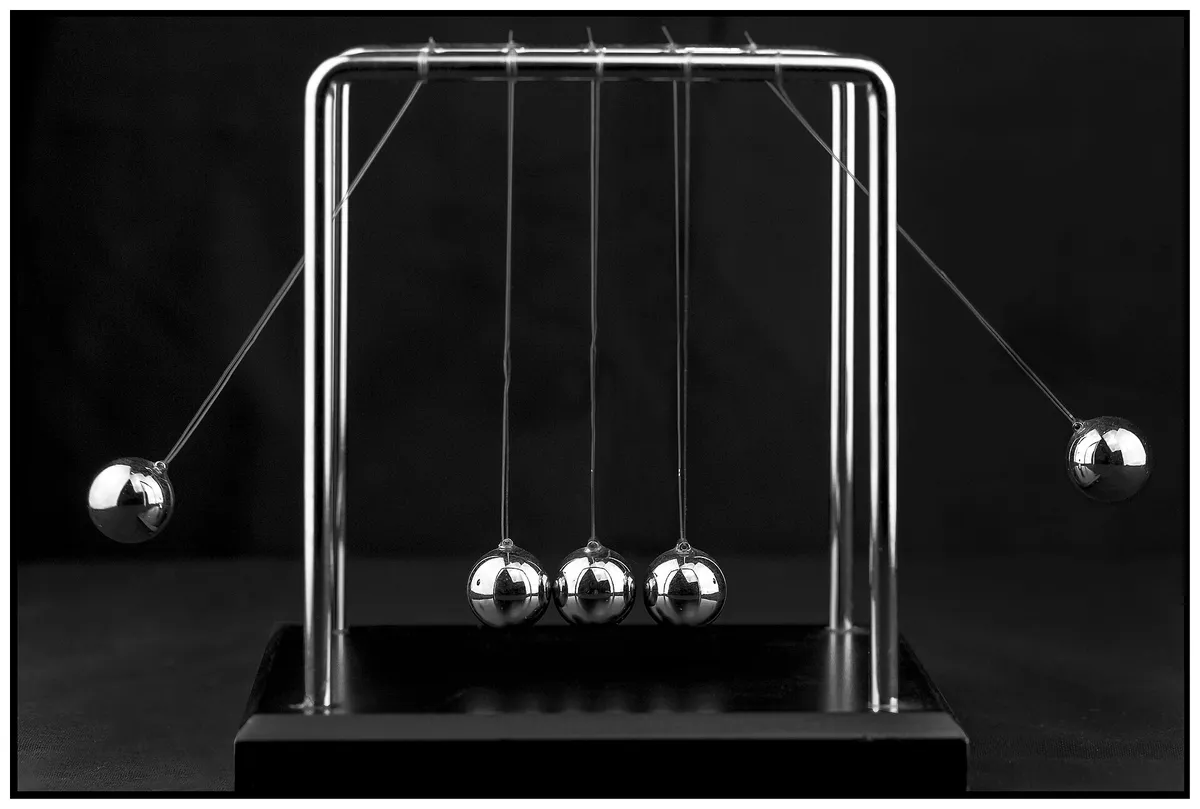
That 'quantity of motion' is : mass times velocity. Velocity has a direction, so momentum has one too. Momentum to the left and momentum to the right cancel when added. That is you and the bag on the ice.
1644: the quantity of motion God put into the universe
The first person to state clearly that momentum is conserved was Descartes. He wrote that God had put a fixed quantity of motion into the world at its creation, and that this quantity neither grows nor shrinks. The idea was right; the arithmetic was wrong. He left out direction and multiplied mass by speed alone. Counted that way, it is not conserved.
Huygens corrected it. From countless collision experiments, plus a thought experiment showing the results must be the same when viewed from a moving boat, he showed that the quantity with direction included (today's momentum) is exactly conserved. Descartes's insight and Huygens's arithmetic together became a law.
1687: two of the three laws say the same thing
Newton's laws of motion are three. The second says that is the rate at which momentum changes; the third says that if you push, you are pushed back equally (action and reaction). Put them together: the forces two bodies exert on each other are equal and opposite, so whatever momentum one gains the other loses. The sum stays.
So momentum conservation was a result hidden inside Newton's laws. Unless a force comes in from outside, however much things collide, explode and push inside, the total momentum does not change.
What does a rocket push against?
How a rocket could move in a vacuum was asked in earnest into the early twentieth century. With no air to push, what does it push against? The answer is the bag on the ice. A rocket does not push air. It throws its own fuel backward. The rocket gains exactly the forward momentum its exhaust carries backward. It needs nothing to push against; indeed it goes better without air.
The kick of a rifle against your shoulder, the thrashing of a fire hose, a squid jetting water to move: all the same law.
Why it does not change
, met in the energy piece, applies here too. If the laws of physics are the same in Seoul and in Busan, here and one metre to the side, that is, under shifting position in space, then there is one conserved quantity, and it is momentum. Momentum conservation is another way of saying 'there is no special place in the world'.
If you know this does not change, what can you find out?
When a particle splits and only one fragment is seen, the total must still be zero, so the mass and speed of the fragment flying the other way can be worked out. The neutron was found this way.
From skid marks alone, the speeds of two cars before a collision can be traced back.
A swing-by, gaining speed past a planet, is the probe and the planet exchanging momentum. The planet slows by a tiny amount.
If a supernova explodes lopsidedly, the neutron star left behind recoils the other way. Neutron stars travelling at hundreds of kilometres per second are indeed observed.
Momentum came from 'the same wherever you do it'. Then what comes from 'the same whichever way you turn it'? The next piece: angular momentum.
The question that remainsLight has no mass. Yet light carries momentum, so sunlight can push a sail and move a spacecraft. If mass is zero, how can mass times velocity be anything but zero? (The answer continues in the piece on mass.)