Concepts explained
Why Energy Does Not Change — The Quantity That Only Changes Form
Energy is neither made nor destroyed; it only changes its form. Trusting that one sentence, people worked out what heat is and found a particle nobody had seen.
is the most used and the hardest to explain of all words in physics. What energy 'is', nobody can easily say. Feynman wrote frankly in his lectures that modern physics does not know what energy is; it knows only that energy can be counted, and that however you count it, the total does not change.
So this piece does not ask what energy is. It asks how people came to know that energy does not change, and what they found out by knowing it.
1740: the woman who dropped iron balls into clay
The first problem was how to measure the 'quantity of motion'. Newton's side said mass times velocity (today's ); Leibniz's side said mass times velocity squared. The two camps argued for decades.
Émilie du Châtelet answered with an experiment. Dropping iron balls into clay from different heights and measuring the depth of the dent, she found that doubling the speed made the dent four times as deep. It went as the square of the speed. This was the moment the quantity we now call first showed itself in an experiment. And the two camps, it turned out, had been measuring different things. Both are conserved. The next piece takes up momentum.
1843: the man who stirred water and read a thermometer
When the ball hits the ground, where does its kinetic energy go? The ball is still and has no height. The energy seems to have vanished. Until the first half of the nineteenth century many people thought exactly that: heat was a separate substance (caloric), and motion was just motion.
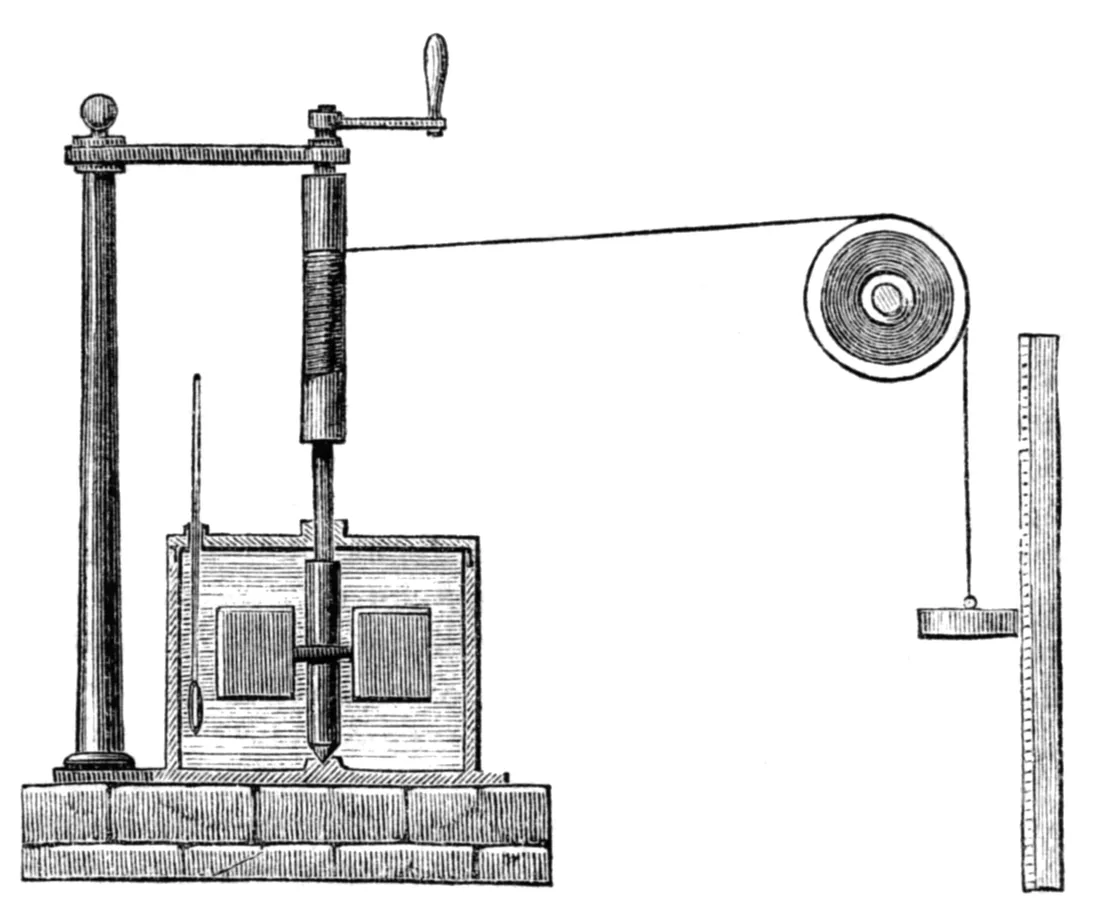
James Joule was a brewer's son, used to measuring temperature precisely. He let a falling weight turn a paddle wheel in water and measured how much the water warmed. The work done by the weight and the heat gained by the water were always in the same ratio, whichever method he used.
What this meant was large. Heat was where the vanished motion had gone. Motion, heat, height, electricity, chemical bonds: all are different faces of one quantity, and the total does not change. The first law of thermodynamics is another name for this sentence.
Unchanging, but less and less useful
Yet the fallen ball does not bounce back up on its own. You cannot gather the scattered heat and throw the ball again. If the total is the same, why can it not be undone? Clausius attached a second quantity here: . The total of energy does not change, but how useful a form it is in changes in one direction only.
This series is about what does not change, so entropy goes no further here. One note only: if a conservation law says 'how much there is', entropy says 'in what shape it is'. The two are a pair.
1930: the man who believed in an invisible particle
In the early twentieth century, when radioactive nuclei emitted electrons (beta decay), the electrons' energies were all over the place: always a little less than calculated, and short by a different amount each time. Even Bohr suggested that energy conservation might fail inside the nucleus.
Pauli refused that road. In a letter of 1930 he proposed that a chargeless, nearly invisible particle was carrying the missing energy away. He himself called it a 'desperate remedy'. But he judged it better than abandoning a conservation law. In 1956 that particle, the neutrino, was detected.
Why it does not change
The reason energy is conserved was found by Emmy Noether in 1918. If the laws of physics are the same today and tomorrow, that is, if they are in time, then there must be one conserved quantity, and that quantity is energy. Energy conservation is another way of saying 'the world is fair with respect to time'. returns in every piece of this series.
If you know this does not change, what can you find out?
Heat is where vanished motion goes. All of thermodynamics began here.
If energy is missing, something took it. The neutrino was predicted 26 years before it was seen.
A perpetual-motion machine that creates energy can be called wrong without looking at the blueprint.
Know the total energy the Sun gives off and you can count how long its fuel lasts.
We began by throwing a ball and arrived at the neutrino. All of it came from one sentence: energy only changes form. The next piece turns to the other quantity Newton's side was counting in du Châtelet's dispute: momentum.
The question that remainsIs the energy of the whole universe conserved? In an expanding universe the symmetry of time is broken, and physicists themselves do not yet agree on a single answer.