Middle school year 2 · second unit
Changes in the Geosphere
The ground underfoot seems not to budge, but inside it is hot and its surface is slowly moving. Rock melts, piles up and is squeezed into other rock. Speed up by hand the changes no lifetime is long enough to see.
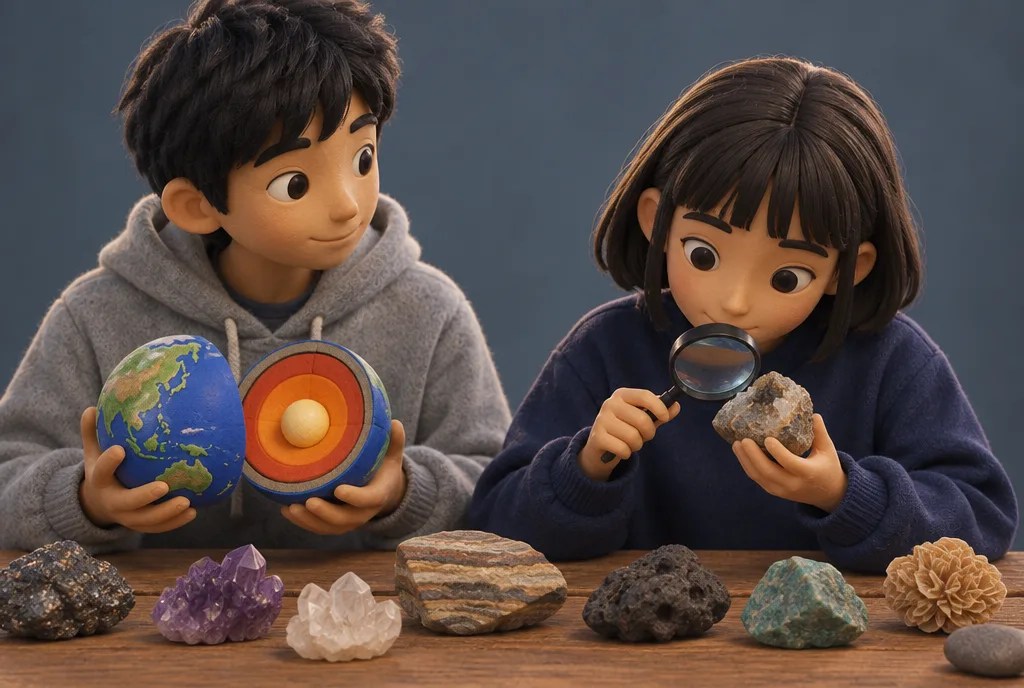
If you went all the way down into the Earth
A board to adjustWhat lies 6400 km down, where nobody has ever been? Take the gold dot and drag it to the centre.
I picked up a golden stone. Is it gold?
A board to arrangeLooks alone will not tell. Drag the minerals onto the streak plate, the magnet and the dilute acid.
Is a rock that rock for ever?
A board to arrangeDrag the rock to the volcano, the sea floor and deep underground. What does it become?
Seashell fossils are found at the top of the Himalayas
A board to adjustHow did a sea floor become a mountain top? Take the plate on the right and push it, pull it, and slide it past.
What to take away from this unit
- From the outside in, the Earth has four layers: the crust, the mantle, the outer core and the inner core. Only the outer core is liquid. Nobody can go there, so this was worked out from earthquake waves.
- Minerals are the grains that make up rocks. They are told apart by colour, streak (the colour of the powder), hardness, magnetism and reaction with acid.
- Rocks are of three kinds by how they formed: igneous rock from cooled magma, sedimentary rock from layers pressed hard, and metamorphic rock changed by heat and pressure. As conditions change they turn into one another: the rock cycle.
- Over long ages rock is broken small by water, air and living things (weathering). When rotted remains of living things mix with those grains, the result is soil.
- The Earth's surface is divided into several plates that move slowly. Earthquakes and volcanoes happen mainly at the boundaries where plates collide, move apart or slide past.