Middle school maths, year 2 · unit 3
Linear Inequalities
A sign at the ride says "130 cm or taller". The heights that are allowed are not one number but 130 cm and everything above it. An expression whose answer is a range like this is an inequality. We start with a tilted scale.
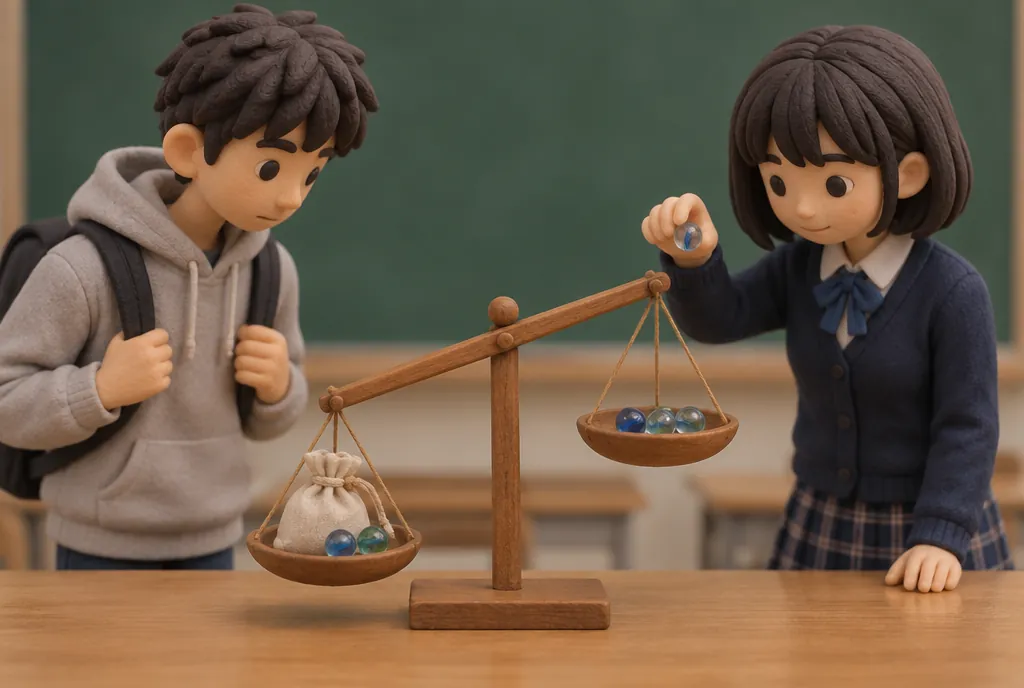
A tilted scale
A board to adjustAn equation looked for the one point where the scale balances. An inequality looks for every number that tips it the right way. Drag the gold handle along the number line to put numbers in for x.
Multiply by a negative and it flips
A board to arrangeDo the same thing to both sides of 2 < 4. What happens to the sign? Drag a card from below onto the number line.
Solve it like an equation, with one thing to watch
A board to arrangeMove the gold-edged cards across the sign, then divide by the number in front of x. At that point, choose whether the sign stays or flips.
From sentence to inequality
Joining boardAt least, at most, more than, under: turn the words into a sign and the sentence becomes an inequality. Draw a line from each dot on the left to a dot on the right.
Try it yourself
Use what you found on the boards. The numbers change every time and the easy questions come first. Get three right and the lamp lights.
What to take away from this unit
- An expression that compares sizes with >, <, ≥ or ≤ is an inequality. The values of x that make it true are its solutions, and they form a range, not a single number.
- On a number line, use a filled dot when the boundary is included (≥, ≤) and a hollow dot when it is not (>, <).
- Add or subtract the same number on both sides, or multiply or divide by the same positive number, and the sign keeps its direction.
- Multiply or divide both sides by the same negative number and the sign turns round, because the numbers flip over to the other side of 0 on the number line.
- Solve a linear inequality by transposing as in an equation, and flip the sign only at the end, if the number in front of x is negative.
- At least is ≥, at most is ≤, more than is >, under is <. "At least" and "at most" include the number itself.