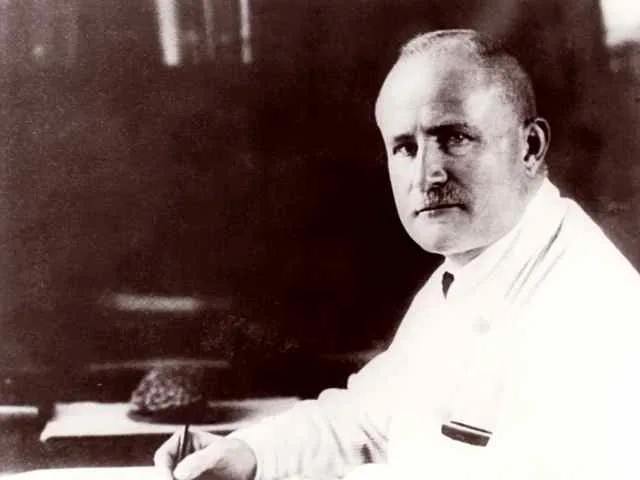
Hans Berger · Brain waves
Can what goes on inside a head be seen from outside?
That time, that place
At nineteen, Hans Berger was thrown from his horse during army training and came close to serious injury. That same day, far away at home, his sister was gripped by a nameless dread and pressed their father, who sent a telegram asking whether his son was all right.
Berger never forgot it. He believed his mind, in danger, had crossed over to his sister.
Why this question
For a mind to cross a distance, something has to carry it. Berger thought it must be some energy given off by the brain, and he became a doctor in order to measure it.
Even as a psychiatrist at the University of Jena he kept experimenting, almost in secret — trying to measure what comes out of a living head without opening it.
What was found
When he placed electrodes on the head of a patient who had lost part of his skull, a very faint electric current was recorded, rising and falling like a wave. Later the same waves turned up on his own son's head.
With eyes closed and at rest, the wave rolled slowly, about ten times a second; with eyes open and attention on something, it turned small and fast. The brain was giving off electric waves without pause, and their shape changed with the state of the mind.
He measured for five more years until he was sure before he published, and he called the waves the electroencephalogram — brain waves.
What happens in a living brain cannot be known without opening the head
A faint electric wave, rolling about ten times a second, picked up by electrodes on the scalp
At first almost nobody believed it. Only when Edgar Adrian in Britain repeated the experiment as a sceptic and saw the same waves did it become widely known. Brain waves were soon used to detect epilepsy, and later became the most important tool of everyone who studies sleep. Telepathy was never found; Berger himself wrote that these waves could not travel that far