Concepts explained
Inception — Does Time Really Slow Down in a Dream?
The backbone of this film is the idea that each level down into a dream stretches time twenty-fold. Yet scientists who woke sleepers to ask them, and who timed dreams by signals sent from inside them, found almost the opposite: dream time runs much like time outside, and physical actions take longer, not shorter.
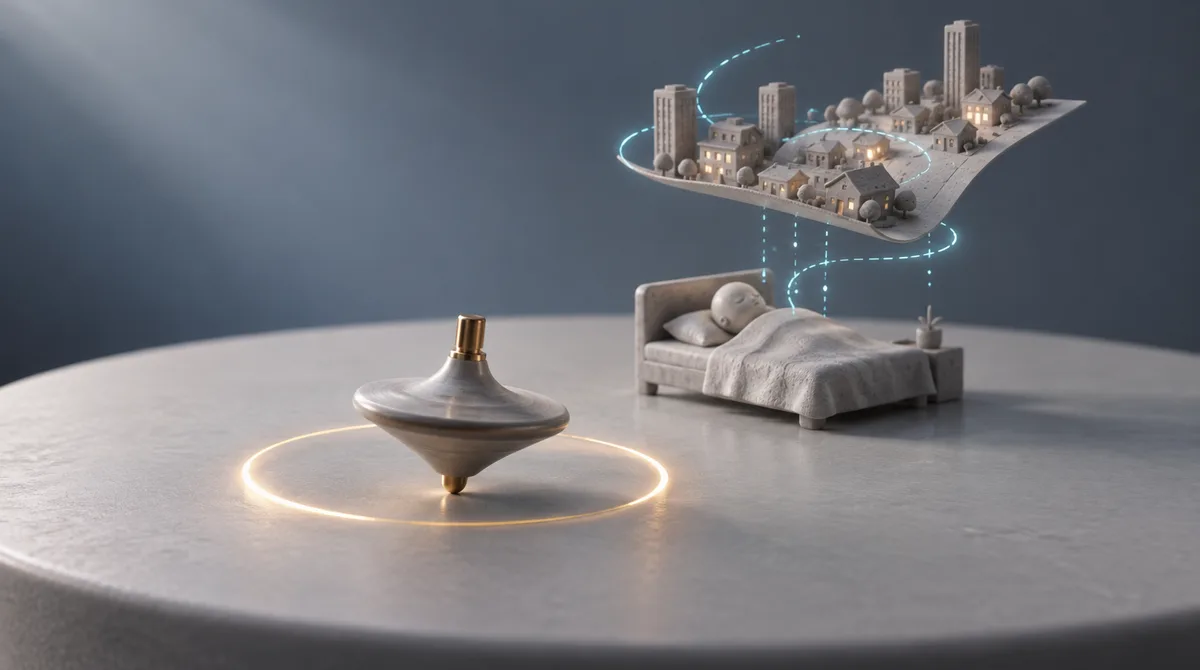
That single feeling is the backbone of Inception. It is also a question scientists have been trying to measure for nearly a hundred years.
First — where in sleep do dreams happen?
To talk about dreams, we first have to talk about sleep. A hundred years ago sleep was thought of as the brain switching off to rest. What broke that idea was an electrode on the head.
The Berger caught were the first window onto the state of a living brain without opening the head. Thirty years later, a graduate student watching sleepers all night through that window saw something strange.
With the discovery of REM sleep came the first way to catch a dream. When the eyes start to dart, a dream has begun — so start the clock then.
Second — how many times longer is dream time?
Kleitman and his student Dement did exactly that. They woke people five or fifteen minutes after REM sleep began, and asked them to choose whether the dream they had just had felt like five minutes or fifteen.
Most chose right. The longer the REM period, the longer the dream report, too. Had twenty times as much time passed in the dream, telling five minutes from fifteen would have been harder, not easier.
A doubt remained: what people say after waking depends on memory. A way was needed to time the dream from inside it. The people who opened that way were those who know, while dreaming, that they are dreaming.
A can carry out an agreed task inside the dream. The researchers asked: when you realise you are dreaming, signal with your eyes, count to ten, then signal again. The time between the two signals is printed straight onto the chart outside.
| What was done in the dream | Compared with awake |
|---|---|
| Counting to ten | About the same |
| Squats | About 40% longer |
| Walking a set distance | About half as long again |
Tasks lucid dreamers were asked to perform in the dream, and how long they took (experiments by LaBerge and by a German team). Dream time did not speed up; physical actions slowed down.
Third — water outside gets into the dream
Yet there is a scene where the film stands exactly where science does. Early on, in the outer dream, the sleeping Cobb is tipped, chair and all, into a bathtub — and water pours into the castle of the inner dream.
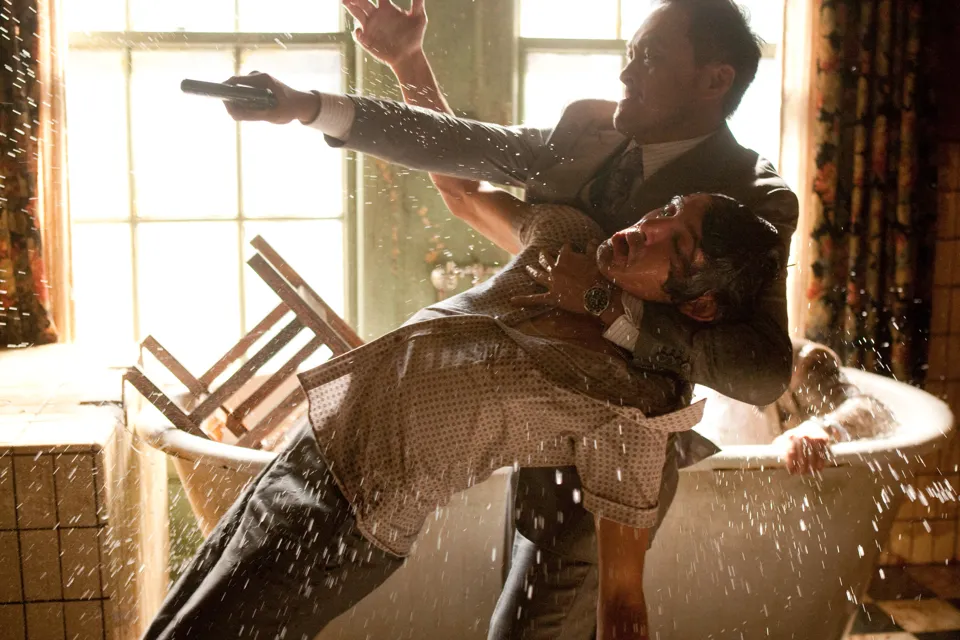
Dement actually ran this experiment. He sprayed a little water on the face of someone in REM sleep, woke them shortly after and asked about the dream. Quite often the water had found its way into the story; one person dreamt of a roof leaking. But the time between the spray and the waking was about thirty seconds, and the dream's events lasted about that long too.
Maury, a nineteenth-century French scholar, thought the opposite. He dreamt at length of being tried in the middle of the French Revolution and dragged to the guillotine — and as the blade touched his neck he woke to find the headboard of his bed had fallen across it. He believed the whole long dream had been made in the instant the headboard fell. For a long time the story was used as proof that dreams pass in the blink of an eye, but since the REM experiments it is no longer accepted: the shock of waking probably wove the memory that way.
Fourth — the falling feeling, the kick
You have probably jolted awake just as you were falling asleep, with the feeling of dropping from somewhere. It is called a hypnic jerk, and it is very common. The kick borrows from it.
The order is different, though. A hypnic jerk happens on the threshold of light sleep, just as you drop off; in REM sleep, where vivid dreams happen, the body is slack and does not jolt like that. The film uses it to wake people from deep in a dream, but the real jolt sits at the entrance to sleep. Waking from a falling dream is common, but that is closer to the dream making a falling scene than to the body actually falling.
A little further in
Can dreams be shared?
There is no machine that puts several people in one dream. But there is an experiment close to what the film imagined: the 2021 study by teams in four countries, mentioned under 'What followed' on the LaBerge card.
Researchers put arithmetic problems to people in REM sleep by spoken words or flashing lights — problems like eight minus six. The dreamer answered two by moving the eyes twice. After waking, one said they had been at a party and the voice from outside came through like a film's narrator.
Someone outside puts a short question to a dreamer, and the dreamer answers with eye signals. It works only some of the time, and only very short exchanges are possible.
Several people enter one person's dream, see the same scenes, move together and design its buildings. No theory or experiment offers a way to share a dream.
Can an idea be planted?
What about the film's title — inception, planting an idea? An earlier experiment from the same laboratory offers a clue. Awake, people learned pictures of objects, each paired with its own sound; during deep sleep, the sounds for some of them were played again. The memories whose sounds had been played held up better.
The top — how do you know it's a dream?
Cobb's top has a scientific counterpart. People practising lucid dreaming build a habit of checking, many times a day, whether they are dreaming. Researchers say that in dreams text changes when you read it again, clock hands misbehave and light switches often fail. When the habit follows them into a dream, that is when they realise they are dreaming.
It is the same idea as watching whether the top falls. Dreams are good at making convincing scenes, but poor at making the same thing exactly the same twice.
What still remains
- We still hear about dreams only after waking. Eye signals opened the way a little, but there is no way yet to read a dream's content directly from outside.
- We do not know why we dream. Memory sorting, emotional sorting, a rehearsal stage — there are explanations, but no settled answer.
- Few people dream lucidly, and fewer still have taken part in experiments. The figures on dream time come from a few dozen people.
Back to the first question
Return to the long dream on the bus. If dream time runs much like time outside, where did the feeling of living half a day in a few minutes come from?
- 19th c.Maury — the guillotine dream and the belief that dreams pass in an instant
- 1924Berger — brain waves caught from outside the head
- 1953Aserinsky and Kleitman — REM sleep found
- 1957Dement and Kleitman — a dream's length follows the length of REM sleep
- 1975Hearne — the first eye signal sent from a dream (in a thesis)
- 1978LaBerge — eye signals from dreams confirmed again
- 2009Sounds played during sleep strengthen memories
- 2010Inception
- 2021Dreamers set arithmetic problems and answer them
The question that remainsIf it felt like half a day in the dream but was really a few minutes, when we feel that time was long, are we measuring time — or counting scenes?