Middle school year 1 · fifth unit
How Forces Act
A force cannot be seen, but it changes the shape of things and the way they move. Feel four forces by hand: one that pulls, one that springs back, one that resists, one that pushes up. The size of a force is measured in N (newtons).
They say you weigh a sixth as much on the Moon
A board to arrangeSo have you lost weight? Drag a 6 kg bag onto the scales on Earth, the Moon and Mars.
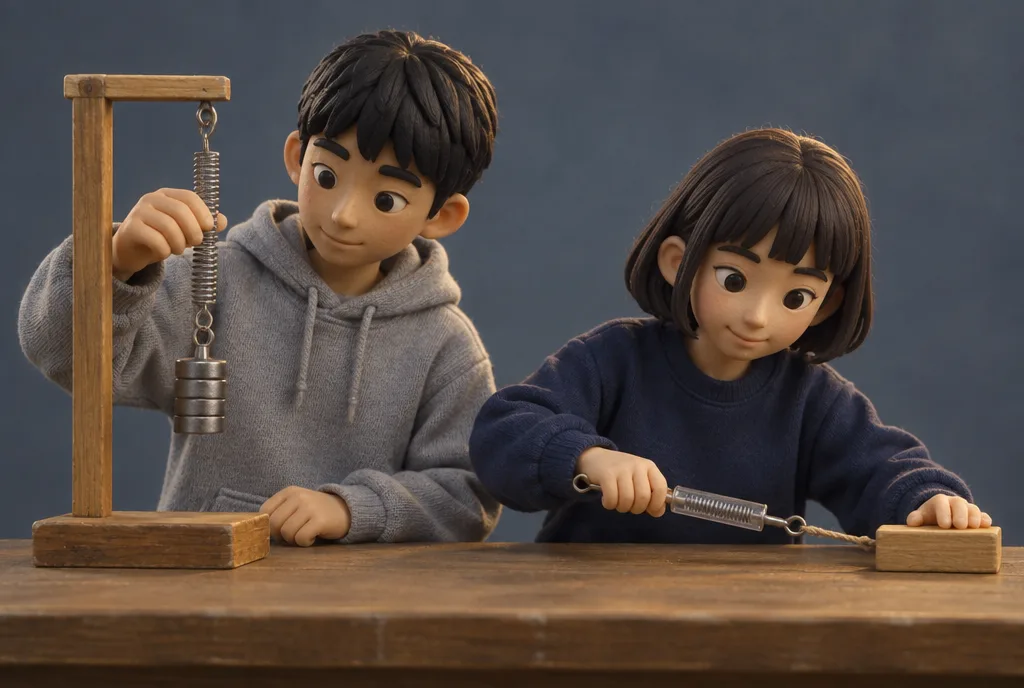
Hang a weight on a spring and it stretches, then stops
A board to arrangeHow much further does it stretch with more weights? Drag them from the table and hang them one at a time.
The same box takes a different pull on different floors
A board to adjustWhere does the force holding the box back come from? Take the box and pull it over ice, wood and sandpaper.
Under water even a heavy stone is easy to lift
A board to adjustHow much is the water holding it up? Drag the block on the spring scale down into the water.
What to take away from this unit
- A force is what changes the shape or motion of an object. Its size is measured in N (newtons) and it is drawn as an arrow: the length is the size, the direction is the direction of the force, and the start is where the force acts.
- Gravity is the Earth pulling on an object. Weight is the size of that pull, so it changes with the place; mass is the amount the object itself has, so it is the same everywhere.
- Elastic force is the force with which an object pushed out of shape tries to return. The stretch of a spring is proportional to the load hung on it.
- Friction is the force at touching surfaces that hinders motion. It is greater the rougher the surface and the heavier the object.
- Buoyancy is water or air pushing an object upward. It is greater the more volume is submerged. You can try more floating and sinking on the buoyancy board.
- When two forces of equal size and opposite direction act on one object together, it stays still. This is called balanced forces.